
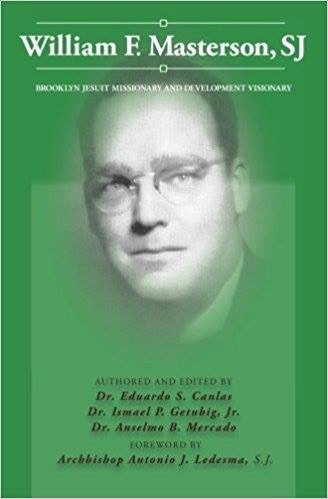
A Father Masterson Memorial Book Project
Thoughts by Eduardo S. Canlas,
Comments will be appreciated
May 21, 2014
Introduction and reflections on a friendship
Sometime in December of 1955 our Ateneo de Davao basketball teams played in Cagayan against the XU Crusaders team, our counterparts with whom we have an annual encounter and on these days our team slept in the room below the bleachers. I remember that that was the first time I ever rode on a DC3 plane, for a fee, I was told, of about twenty pesos per, and compared to Davao, Cagayan town was quite dull and dusty.
Several years later, I was on the bleachers of the same Ateneo gym, now cheering and shouting boisterously during an Artscies-Aggies game, and together with George Arguelles and Eddie Maniego we were shouting “Bangus-bangus!” at a certain mestizo player Franco Badelles, son of an Iligan congressman, when Father Masterson, fuming mad and red faced, went up the steps to where we were anonymously ensconced , and effectively told us to behave. I must have disrespected him because at that moment he lost his cool and slapped me in the face.
That was the first time I met Father Masterson. And it was an encounter which, after contrition and apology. became a friendship, which later became a father-son relationship, and which lasted up to the day, some decades later, when he died. He had grown old, and one evening he asked me to fetch Fr. Stanislaus Hsu, S.J. to hear his final confessions. Weeks later, with his Jesuit brethren praying at his bedside, he died.
Allow me to tell you of my recollection of the man who became a legend among his confreres in the emerging world arena of peace and development, but not before he endeared himself among his students and faculty, his friends and the parents of the students of the college he founded.
If we were loyal to him, and I mean “we,” it is just possible that our loyalty stemmed from the fact that there was always a “pasalubong” for us whenever he came back from his begging tours abroad. In that respect he was more Pilipino than many of us will ever be.
Co-workers, yes. but friends too
We, who were his faithful few co-workers and friends never realized that we were in close, daily contact with a man of great dreams and ideas because all we felt was his warmth, his friendship and often his righteous ire.
That he was made of stuff that foster legends was lost on us. But soon enough, as the great Jesuit universities in the U.S., as the Catholic hierarchies of Europe, especially Germany and other government and non-government agencies took cognizance of his labors for the poor of Asia, we realized too, that we were palsy-walsy with someone who had greatness in his bones, and naturally we also basked in his reflected glory, which indeed never affected him personally, except insofar as it goaded him to “beg” for more assistance from his benefactors and contacts, all for the poor that constantly were in his heart.
In fact he used his honorary degrees from Fordham. Loyola University, etc. as well as his “Ramon Magsaysay Award,” to build his science foundation fund, which sad to say, is now not significantly being added to by his university, which incidentally, have grown rich because of properties which Father Masterson himself helped to acquire in what has now become known as “Xavier Estates.”
For his university, like the church of which it is part, has grown so rich that it elicited from one of its members, the late Fr. Art Shea, the comment that “ our church can survive many challenges, but one of the most difficult one would have to be that of wealth.” Today, in fact, the crown of what was known as a trilogy of development model: the SEARSOLIN institute, together with its rural outreaches, is shut down, possibly because, unlike its originator, successive administrators do not anymore relish nor do they feel disposed to “beg” to have to keep the works of the institute going, and this institution is now empty and unappreciated.
What? Ordained beggar? One with a vision?
Father Masterson prided and called himself as an “ordained beggar,” probably in emulation of St. Ignatius who himself was actually one by choice.
Son of a Brooklyn physician who was co-founder of the U.S. Blue Cross/Blue Shield medical insurance system, Father Masterson founded an agricultural school which he conceived because he believed that
“agriculture’s greatest need is still the training of a generation of farmers that will look at agriculture not as a big business but as a way of life; men who appreciate fully their responsibilities to their family, church and nation; who will till the soil with reverence and safeguard its riches for their children, men who will have sound agricultural fundamentals without the ambition to be one-crop specialists; men enjoying and realizing the wonders of ownership yet devoid of the overpowering desire to accumulate more and more land, or even a white collar.”
While many associate the song “Impossible Dream,” not only as his personal credo, the lyrics of which is embossed in bronze seen by all who enter his office, and which his many friends sing de rigeur with him during the annual institute graduation and send-off rites, the phrase quoted above may also be considered as the Aggie college’s collective credo for it preceded the dream song, by years.
This collective credo was in Father Masterson’s personal stationary and spoke of how he wanted his students to become.
Indeed, as a belief system, it was a complex and a tall order and while he never explained nor alluded to it in spoken words, his actions told those around him what it was he was trying to accomplish.
For instance, he expected all his Aggies to go to Manresa, the farm which we loved to call as “Masterson’s penal colony,” and work there practically all mornings of the week save Fridays, during which occasions he would take his bully pulpit and talk our ears off; expounding on the virtues of hard work and perseverance, capping it off with instructions for many of us “to be sure to pass by the college dorm refectory” to collect the swill and all the hogwash; making sure that the half drums where this stinky, swirling food wastes would be collected do not spill off inside the school bus, the same vehicle we rode, to bring the daily feeds to the swine herd in the farm, where not only are we tasked to remove stumps of trees so that tractors can plow our fields, but also where guava trees and santol trees would also need to be pruned and spruced up for grade schoolers to have some place to appreciate nature and pick guavas from, during weekends.
The entire regime of labor and back breaking activity on this farm was matriculated for by us, and for which we received grades as well. Technically, work on the farm earned us “lab units.”
While some of us wondered at and/or were fully envious of the more spic and span and highly scientific labs in other schools, especially government owned ones, a few of us can see that
“agriculture’s greatest need is still the training of a generation of men who will till the soil with reverence…safeguard its riches for their children… men who will have sound agricultural fundamentals…etc”
The college farm was appropriately called “Manresa,” and “rock and roll,” was a phrase that was quietly literal for us, who had to cut our teeth on this “valley of tears,” and to my knowledge, there were no violent resistance to the system as we knew it, for we realized that work on this college farm was just a “morning affair,” for we were rarely, if ever asked to labor in the afternoons, which, rightly, were reserved for some moments of rest before one prepared oneself for attending lectures and other academic pursuits when we would hie off to use the school classrooms and facilities of the university, after the grade schoolers and the high schoolers were done with them.
That was Ateneo de Cagayan in 1950’s, the period when Father Masterson was assigned head of the college Sodality, with duties as Guidance Counsellor, lecturer in Theology and Rhetoric and founder of an agriculture school, the only other Jesuit school of agriculture in the world that is run by a religious order known for turning out intellectually adequate alumni but not agriculturists; which many of the world’s families would recommend as the chosen specialization areas for some of their sons who may not otherwise make the profession of being a doctor, a priest, lawyer or this or that field which supposed required more brain and less brawn.
We personally heard Father Masterson essay his opinion on this matter, and like sponges we just absorbed all this and just wondered and did our best.
Masterson, the enabler
Fortunately Father Masterson was just as aware of what we dreamt about or worried about or what we were concerned with, and he involved himself in our lives whether we liked it or not.
For instance, if you have a grade of B in Trigonometry taught by Engr. Ernesto Silvela or another B in Chemistry taught by Manuel Quisumbing (him, whom we called Mr. Q), Father Masterson made sure or worked his charm on your teachers to make sure that they ticked your marks up to a B+, that one little jump of a mark that would earn you a “Second Honors,” a mark that would be a first in your short, entire academic “career,” a mark that would allow you to march up on the stage to be recognized.
Not only by the academic honchos of the school, but also by the girls who would have already known you and cheered you as a player on the basketball court, and who now would have some doubts about their impression that you are actually a dolt and a boor, but now could possibly be a “gentleman-scholar” as well.
When I was a freshman in the Aggie school, I needed role models to look up to, and in a small college I admired those who excelled in sports and those who excelled in academics, especially those who read books. And so I identified and found them.
In our own Aagie College I noticed that of the very few seniors that practically all of them marched up on the stage to receive “First Honors,” certainly a most remarkable thing, I would say to myself. And not only that, many of them had as girl friends the best looking girls in town. Not that this was a universal thing, but with this probable scenario I was happy to with a college like this.
Years later, when these students were recruited and had successfully made their mark in the world of work I was mindful of the fact that when I was with them in the college fields of Manresa I observed them in their best element of hard work and ingenuity, never mind that for some of them, their grades, like mine, were somehow creatively ticked up by our protector, best friend and college dean.
When Dr. Anselmo Mercado was in high school and deciding on a college degree he was advised by Father Masterson “to be the best person you can ever be,” and with that advice safely tucked in him, he went on to become one of the successors of Father Masterson in the College, one who never looked back nor regretted.
He had enough dreams. For God’s work. For Others.
Father Masterson was not only a man who dreams for others and for what his vision and work in peace and development would imply for others, but he was also a realist as well.
He was the first to admit that other institutions and other jobs had more promise and pay than what a small college like his, could offer. But he always tried to make things better for you in your job or in whatever it is you are doing in his employ.
For example: When Cagayan was a small, wee of a town, he urged us to acquire land. He wanted us to have roots in Cagayan because that is where he labored and we were supposed to labor with him in this particular vineyard.
He figured that if we had no roots, that we could easily be cajoled, nay, lured to work for prestigious multinationals or some similar firm, and he did not want to have to constantly recruit new believers.
If we said we had no money to buy land, he identified lands that could be bought and advanced the money, which he then deducted from our salaries.
This is one way he kept us in his employ, and partly the reason we stayed. We complained a great deal, under our breath, about the low pay we were getting but not because he did not try to give us more. For in fact he did try to make up for the low pay in ways too numerous too mention.
He did not say it out loud but implicitly he wanted us to keep the faith. To keep the faith in the Lord that he followed. He did not force anyone, but any stupid person would have to think and wonder how fervent and devoted and faithful he was to his Friend and Lord.
A priest who loved much
He to Whom he shared his life, dreams, his frustrations and sufferings: and that suffering included us, his co-workers who sometimes did not keep the faith and on one occasion complained to his superior about work conditions and all. This was one time I saw him hurt visibly and he complained to us why we we were not faithful. “Why were we so emboldened when he was away?” he asked.
By and large, except for some lapses, we stayed with him and we persevered. After he died things were never the same. One day we woke up and discovered that his dreams for us made us rich beyond our wildest imaginings. The university that he was loyal to, and never, ever bad-mouthed even when they made it difficult for him in terms of lending him resources or even for using funds he raised for purposes other than that stipulated by donors in their giving, this university also became rich.
When Father Masterson was still alive he told us in so many words that when he died, he did not want his superiors to say that he “never acquired enough lands when he could have.” and this too has come to pass.
It is my conjecture that when he was exiled from Ateneo de Manila it is quite possible that the reason for it was not because he acquired too much land, so his confreres could concentrate on their work in the vineyard of education but because they believed that the will of God is expressed in the will of one’s superiors, right or wrong, wise or not, for to obey one’s superior is to obey God. For, as Fr. Jean-Pierre de Caussade, S.J. said a century earlier:
The soul that does not attach itself to the will of God will find neither
satisfaction nor sanctification in any other means however excellent by
which it may attempt to gain them. If that which God Himself chooses for
you does not content you, from whom do you expect to obtain what
you desire?
No soul can be really nourished, fortified, purified, enriched and
sanctified except in fulfilling the duties of the present moment.
Fr. de Caussade further says that “ the duties of each moment are the shadows beneath which hides the divine operation.”
I have often heard Fr. Masterson used the words “divine operation,” and I have wondered whether the phrase might be too “technical” a term especially since the word “operation” when Pilipinized, connotes surgery.
For Father Masterson the duties were those related to guidance counseling, teaching and directing an agricultural school. The “present moment” encompassed the decades that he spent in Cagayan.
God was always there, hidden in the shadows of the present moment waiting daily to be discovered. And the “divine operation” never faltered.
Pages: 12
 BCBP Ohio Journal & Learning Resource