

Cagayan de Oro in the 60’s : My town, your town
(Excerpted from my book “A Camiguin Island in Mindanao and The
Houses of My Life.”) http://www.amazon.com and http://www.kdp.amazon.com
By Eduardo S. Canlas
Though I do not live in Cagayan town now, and had visited it twice since I left in 2004, my
mind often goes back to it, warming my heart and making me quite sympathetic to the
present difficult traffic and hustle and bustle in a town that once upon a time was a
somnolent, dry, unpretentious, and uneventful town, just a newly chartered city,
actually just a village overgrown, when I first set foot on it.
That was in 1958 when on a twenty- peso plane ride from Davao, our PAL DC-3 Douglas
aircraft landed on the gravelly runaway in Lumbia, then driven to town by the so-called
“PU car –for- rents” to the also graveled Corrales street, to a boarding school that was to be not only my spiritual home but also, in a sense, my life.
The school was Ateneo de Cagayan.( now Xavier University)
I was just one of the “boarders,” as we were called then, but we had come from all parts of southern
Philippines, though some came from as far as Baguio or Ilocos in the north but majority of
us were from Cebu, Negros, the Visayas or Mindanao.
But growing up, away from family, however, was neither sweet nor always hunky-dory, but was
often necessary and sometimes, life-changing.
Allow me to share one account of our life as “boarders” in Ateneo in the early1960’s, one
written by Bube Mendezona, and taken from his book “How Sweet the Mango, No?”
Bube was the youngest of three Basque mestizo brothers, Inaki, Johnny and him who were
sent to Cagayan by parents who had land holdings in Siocon Valley in Zamboanga del
Norte where educational opportunities were, to put it mildly, lacking
After completing their study under the nuns, Inaki and Johnny
Were shipped out to boarding school on a trial basis. “The next year
at the age of nine I followed my brothers to Xavier University.
My dorm housed the boys from ages seven to eleven and was separate
from my brothers’ dorm. I was nine. I cried quietly underneath my mosquito
net every night for the first two weeks.
Yet strange things happened from the first day. In fourth grade class, every
word the teacher said entered my head effortlessly.
In the dormitory we were awakened by a bell at 5:30 a.m. and had half an hour
To wash up, make our beds, and march off to mass. After mass, we all filed
quietly into the dining hall and stood erect in front of our seats.
“Attenshun,” an appointed dorm mate called the “brigadier” would shout out.
Followed by prayers, “Bless us O Lord…” then the next command: “Take seats.”
Lunch and dinner followed the same routine, Monday to Friday and every weekday evenings were supervised study period for three hours. By 9:30 p.m. we were in bed for prayers.
A Jesuit scholastic walked among the beds in the dark as we fell asleep.” ( End of Mendezona’s reflections)
This depiction of life by Bube Mendezona in the Campion Hall dormitory was one that actually began in Cagayan de Misamis
even before the outbreak of World War 2 and continued until the late 1960’s, when finally the lack
of priestly vocations slowed down the supply of Jesuit scholastics to man the dorms, all of
which gave way to new buildings when the main Campion Hall burnt down one day in the
1970’s, never to rise again.
Really, Cagayan is a special city because of the so many people who lived in that city and who
continue to live there who honored God in the way they took care of the place: planning its
growth and development, fighting for its river and its life giving attributes; defending the city
from low minded folks whose obsessions are power and fame and money; giving it their
hope and a faith that can overcome even poverty; fostering a culture which values
democracy while abhorring cheatings and cheaters.
So it was in 1958 I desired to study in Cagayan because of basketball. And I made the team there under
Coach Nene Velez, but barely. My better team mates were Boy Barga, Tano Dolores,
Butch Gabutina, Tony Cabading, Rudy Chua, Paking Mercado, Ben Tagam, Eddie Raagas,
Salvador Yee and others. We played against teams like San Carlos from Cebu and the Rafael Palma College in Tagbilaran where the fans behind the goal posts would hit you with their jackets when you made a layup and fell unto them.
Cagayan was the town I “ran” to when I had to, early in my life as a teen because I knew
that there was a school there that was similar to the Ateneo in Quezon City where I often
watched the Blue Eagles play the San Beda team; when players like Jose Cacho,
Battallones, Frank Rabat and others played the likes of Tony Genato, Caloy Loyzaga,
Loreto Carbonnel and Cezar Jota at the Loyola Heights gym.

Ateneo de Cagayan varsity 1958 ( top row, rightmost was me)
In Cagayan at that time, you either were into sports, busy at school, ogling the girls. busy
earning a living, playing bowling or just plain riding around in “tartanillas” because
literally, there were no places to go, and travel distances were short. For instance, if one were to
go from the Bonifacio monument to Corrales corner the national highway, one would
already reach the edge of town. Cogon market area, before it was built, was also the edge of
town. The river’s edge was where the poblacion centro began, and Carmen barrio, was
well, literally “probinsya.”
A walk from the Ateneo gym would bring you past Hernando’s
Hideway (owned by Judge Hernando Pineda), past Tony’s Studio (owned by Antonio
Malferrari, Sr.), past the Quonset buildings on which were movie houses on the lot owned by
the wife of Mayor Borja), past the gazebo, past the “Mindanao Lumber” firm of
the Go family, past the Bombay store of Dadlani, and past the Casino Ice Cream parlor of
the Gabors, the family with the lovely daughters, and finally the town market which looked
like any old municipio town market, replaced today by a pedestrian staircase that dreams of
becoming a bridge, purported to bring one on a promenade across the river, but which
would qualify perfectly to be called a “boulevard of broken dreams,” for how could one call
a mock up of a bridge that today leads to nowhere?
I liked the smallness of the town because with short strolls one can almost reconnoiter the
entirety of the town, if one were patient. Or if one were a more intrepid type, like Fr.
McFadden, one can also trek up the hill towards Pryce Hotel, which at that time was not yet in
existence and the road towards Lumbia had a few occasional jeep or truck plying, and the
last one being that which rounds the curve at 4 or 5 p.m. when the last plane was dispatched for Manila.
It is for this reason that living outside of Cagayan poblacion was not easy for poblacion
dwellers, and the reason too, that it had to take someone like brave couples Baging and
Linda Arguelles to dare to farm a property on a bluff directly opposite the airport, raising corn and santol and white leghorn layers for the small egg market that were personally pedlled either
by Baging or Linda or her brother Bebing.
Indeed, Cagayan in the years before 1970 were years where a rural town was trying very
hard to be a respectable city.
A visitor driving down from the airport would, in the early evening, would be greeted by a
pall of low-lying haze of whitish smoke, lingering witnesses to the busy end-of/day-cooking
over wood-fired stoves; for in those days, the town’s electric utility company did
not extend over the river, because Carmen was mostly a river valley populated more by
carabaos and “camanchile” trees, not like today.
But is Cagayan de Oro really a Special Place at all? as they say.
For one, we know that because of the missionaries’ work, the Christian faith in the city is
one now anchored on “deep soil” And because of this faith, especially that held by Catholics, “is
the mother of Jesus looking over the city in some mystical or metaphysical manner?” No one can really, scientifically prove this, of course, unless one “sees” with the eyes of faith, and who
have these eyes, but the faithful?
Certainly one cannot fault Archbishop Santiago Hayes, who, once in a letter mentioned
having witnessed the “dancing of the sun over the horizon”, above the
Balulang ridge line west of his residence, and this, when he was called by the faithful to see it, and who, coming from the cathedral, witnessed it with his praying flock, gazing at the heavens. (Source: Abejo)
In late1980’s, in Balulang some children there again witnessed a similar phenomena and in a
letter I had said:
“We know that the country is entering into some sort of a crisis situation ( it was the Martial Law years).
But how much more serious it could be is anybody’s guess. Suffering is
on a scale never before realized in this country, both due to natural causes
(typhoons, floods, volcanic eruptions, droughts) and political causes .
Even our Church is calling for the faithful to fast, to repent and to pray to
forestall whatever horrors may be in the offing.”
This, of course, was way before typhoon Sendong was visited upon our city, the one catastrophic event no one will ever forget.
Cagayan never lacked for folks with visions or dreamers with grand dreams.
One of these was Father Masterson. He purchased that “uptown” land full of stones, and though we
were all enrolled in his Aggie school, we had to work in this land which to me was like a
“penal colony.”
When Cagayanos were still a sleepy lot, it also had dreamers and visionaries like Father.
But he was not the only one ( more on these later). Father Masterson also organized SEARSOLIN (Southeast Asia Rural Social Leadership Institute). ( See photo below)
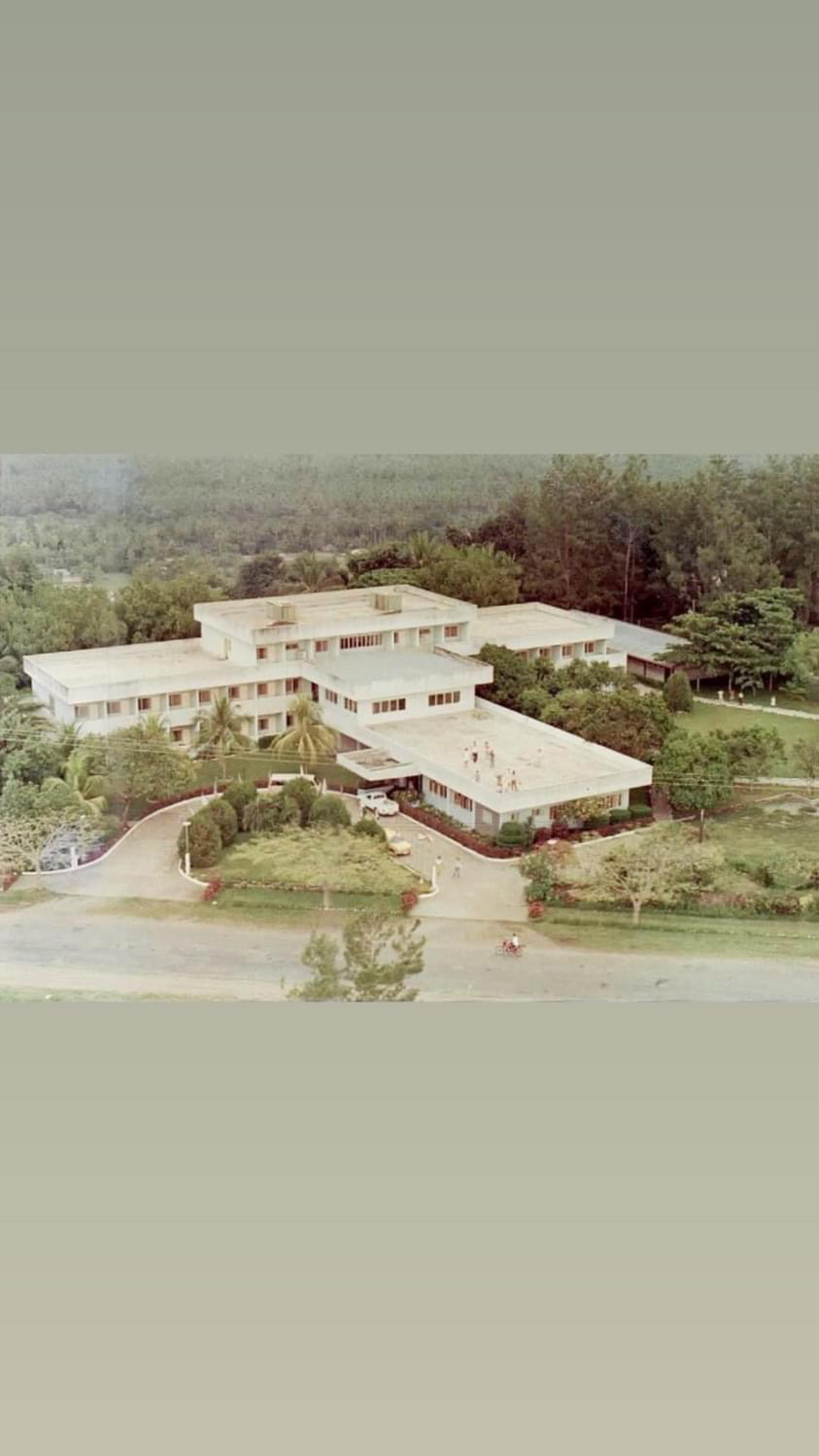
And I remember the night we coined the name “SEARSOLIN,” and it was evening in his office
before he sent us (me, Manny Daguay, Emil Neri, Boy Mercado, Ed Chaves, Father
Macalam, etc) to study cooperatives in Nova Scotia, and I said to Father Masterson: “SEARSOLIN”? Why, it sounds like an insecticide to me.”
Good enough, when SEARSOLIN was inaugurated at a ceremony in the audio-visual
center, where Fr.Quirke and Mr. Henry Canoy and Mayor Borja were in attendance, the
first thing Mayor Borja said when he addressed the audience was, “ Father Masterson,
what is this “SEARSOLIN” all about? Is this an insecticide?”
Before SEARSOLIN, one might say that Cagayan was a “probinsyano” town whose special
visitors were the “big shots” from Manila or from outside, but was never or was rarely
ever visited by foreigners, except of course, the missionaries. So when my daughter Susan
married Bobby Bolongaita sometime in 2003 and Bobby had as his best man a black Ghanaian
classmate from Northwestern University who looked liked Louie Armstrong of the trumpet
fame, the very first thing that Tony Malferrari Sr. asked him, as they met at the church door
was, “Are you a SEARSOLINer?”
And that, my friends, was how the SEARSOLIN institute became seared into the minds of Cagayanos.
God bless our beloved Cagayan de Oro.
Today the spiritual leader of the city is Arch. Antonio Ledesma, S.J. His leadership and concern for the deluge that visit our river poblacion is something our people and our political leadership must address. As a people of faith we need to heed our leaders’ call for common sense and need for preparedness.
 BCBP Ohio Journal & Learning Resource