
Introduction
Here I serve as tour guide to this my world, my island, my world view. A guide who is a “Pilipino pilgrim” in Ohio, a “Buckeye” who cheers for the Celtics and the Golden Warriors, was formerly a visiting prof at The Ohio State University, formerly a president to two state colleges in my home country, an author of three books who loves and who tries to love a God he has not seen, whose Presence and works are out in full glory not only in our universe, but also in my own life, in my family, friends. Am now a granddad whose entire life is now spent driving wife and grandkids to work and to school. Gratefully, this is my portion and lot and tis’ said that if a “Thank you,” is all the prayer that one speaks to God in one’s life, that “that would be enough.”
Yes , I golf too. So life at 84 can still be fun, with God’s help. I tend to be fearful and is somewhat of a psychosomatic person ( one who would imagine that the things he fears about just might come true?). I therefore am one who tries his best to pray daily, to be the best Christian he can possibly be, and one who strains to practice Hope, to live in Faith, and to Love God. I try going to mass daily and I try to end my day with a prayer to my guardian angel.
St. Peter says: “Although you have never seen him, you love him, and without seeing you now believe in him, and rejoice with inexpressible joy touched with glory because you are achieving faith’s goal, your salvation.”
What do I believe in and a prayer that I say
Me, I don’t believe in magic, but I believe that there is more to life than our years on earth. I believe that we are not meant for the grave but destined for what is beyond it. To be more specific, I believe in the song: “Lord, we are called by your name. We belong to you. We are called by your name, we are yours.”
One of the greatest emotions felt by humanity is precisely this: To belong. But to belong to whom? To belong to what? For us Christians, we long to belong to God. To belong to Jesus, his Son, Our Lord.
Who is this Lord that we cling to? His name is Jesus. And why do we believe in him? Well, we used to say in our masses decades ago: “Christ has died. Christ is risen. Christ will come again.” If Catholics have one “award winning” meme, this could be it. But we are not a people who rely on memes alone. We do read the testimonies of Christ’s apostles and disciples and martyrs, etc.
To me, the following passage from Luke is good enough. But there are, of course, many, many words in scripture that can convict even the most cynical.
“Soon afterward he journeyed to a city called Nain, and his disciples and a large crowd accompanied him. As he drew near to the gate of the city, a man who had died was being carried out, the only son of his mother, and she was a widow. A large crowd from the city was with her. When the Lord saw her, he was moved with pity for her and said to her, “Do not weep.” He stepped forward and touched the coffin: at this the bearers halted, and he said, “Young man, I tell you, arise!” The dead man sat up and began to speak, and Jesus gave him to his mother. Fear seized them all, and they glorified God, exclaiming: “A great prophet has arisen in our midst.” and “God has visited his people” This report about him spread through the whole of Judea and in all the surrounding region.” (Luke 6: 11-17)
This backdrop, hopefully, can help you to navigate this road map of my book, meandering over my particular time, space, ideas and beliefs, houses, islands, streets, towns or cities and more importantly, over the inner workings of my heart and of my faith. It also shows that my faith is based on hope. If Jesus can raise a boy from death, it means that Jesus, the God-man has power over the greatest natural evil known to man, and it means that death is not the end, but that there is hope after the grave.
Over the years I had truly, but regretfully spent losing my way, in the earlier segments of my life, those years when God in his divine providence had seen to it ( despite myself) that I “follow not the wrong path and led me or leads me, in the path of life eternal.”
As scripture would have it:
“Then they cried to the Lord in their need
and he rescued them from their distress
and he led them along the right way,
to reach a city they could dwell in.”
Not that I was always on track, as it were ( for I had often wandered into dark paths and byways that brought me nothing but misery,sorrow and guilt), but only, that God had steered me back into his path. This, I can be a witness to, for God’s mercy in my life has afforded me some degree of peace, a peace that even the world cannot give, but only God can.
In this book of my life, there are houses, islands, towns and cities, countries even, plane rides and highways, quiet nights and moonless ones, quiet weeping for loves lost and loves regained and, well, tales of the things humans do and think about. Simple things, complex things and yes, hazy-at-times things. It’s all here, and more. Throw in family schizophrenia, moments of forgiveness and of peace, even dancing with fathers: they are all here. There are songs, prayers, hymns, spiritual journalizing, etc. The book also takes you to places like Davao City, Cagayan de Oro, Camiguin Island, Hokkaido island, Columbus, Ohio, Pangasinan, and Cincinnati, and Springfield, Ohio, Nova Scotia, Canada.
As American country singer John Prine would say: ” I’ve been down this road before, I remember every tree, every single blade of grass holds a special place for me. And I remember every town, and every hotel room, and every song I’ve ever sang, with a guitar out of tune. I remember everything, things I can’t forget. The way you turned and smiled on me, on the night that we first met. And I remember every night, your ocean eyes so blue, how I miss you in the morning light, like roses miss the dew.”
On some page of my book I shared a prayer akin to this song of John Prine. And the name of the prayer is: “A Prayer for the world I’ve seen.” It is a prayer taken from the book, “Prayers by Jesuits.”
It goes: “Mighty God, compassionate God, Father of all, bless every person I’ve met today, every face I’ve seen, every voice I’ve have heard, especially those most dear to me. Bless every city, town or street I’ve known in all my life. Bless every sight I’ve seen, every sound I’ve heard, every object I’ve touched. In some mysterious ways, these have all fashioned my life; all that I am and all that I have received. Great God, bless the world that I’ve seen today.”
Although practically everything that happened to me in life is in a sense, remembered, some sights, some streets, some towns, some cities and some persons are more remembered and more loved than others. I usually say this prayer before I retire at night, and my intention in praying this is clear enough to Our Mighty God, the Father of all, who gave us everything which, in their own mysterious ways sustained and sustains us, and continues to create us.
One of my readers from North Carolina had this comment: “I greatly enjoyed how you interspersed prayers with inspirational lyrics as well as stories from your own life, and parables. Your insights are very poignant and philosophical and I truly got the sense of being privileged to understand your particular view of the world.” ( page 13)
Boldly I begin by saying that only fools and atheists in their abnormality, full of themselves and lacking wisdom fail abysmally in their prideful incapacity to see the God who loves us in ways we can never fully comprehend. So God sends his Son, his Word, so we can understand, we can repent and be saved.
From ancient times, the Church had always prayed The Liturgy of the Hours, to fulfill Jesus’ command “to pray without ceasing.” One of these prayers I quote below. Imagine man at work in the field. Imagine man take his rest. Imagine the world and the universe God created making its rounds in the heavens above. Imagine our short existence rising in the east and sinking in the west. Imagine the sun unable to go astray. Imagine our spirit able to go astray. Then understand why prayer is necessary.
“Each field is then a hallowed spot, his rest
an altar in each man’s cot,
a church in every grove that spreads
its living roof above our heads.
Look up to heaven! the industrious sun
already half his race hath run;
he cannot halt or go astray,
but our immortal spirits may.
Lord, since his rising in the east,
if we have faltered or transgressed,
guide, from thy love’s abundant source,
what yet remains of this day’s course;
help with thy grace, through life’s short day,
our upward and our downward way;
and glorify for us the west,
when we shall sink to final rest. Amen.”
Saint Augustine gives this advice On Prayer.
He says: Let us exercise our desire in prayer
“Why in our fear of not praying as we should, do we turn to so many things, to find what we should pray for? Why do we not say instead : “I have asked one thing from the Lord, this is what I will seek: to dwell in the Lord’s house all the days of my life, to see the graciousness of the Lord, and to visit his temple? ” There, the days do not come and go in succession, and the beginning of one day does not mean the end of another; all days are one, simultaneously and without end, and the life lived out in these days has itself no end.
So that we might obtain this life of happiness, he who is true life itself taught us to pray, not in many words as though speaking longer could gain us a hearing. After all, we pray to one who, as the Lord himself tells us, knows what we need before we ask for it.
Why he should ask us to pray, when he knows what we need before we ask him, may perplex us if we do not realize that our Lord and God does not want to know what we want (for he cannot fail to know it), but wants us rather to exercise our desire through our prayers, so that we may be able to receive what he is preparing to give us. His gift is very great indeed, but our capacity is too small and limited to receive it. That is why we are told: Enlarge your desires, do not bear the yoke with unbelievers.
The deeper our faith, the stronger our hope, the greater our desire, the larger will be our capacity to receive that gift, which is very great indeed. No eye has seen it; it has no color. No ear has heard it; it has no sound. It has not entered man’s heart; man’s heart must enter into it.” ( taken from Augustine’s letters)
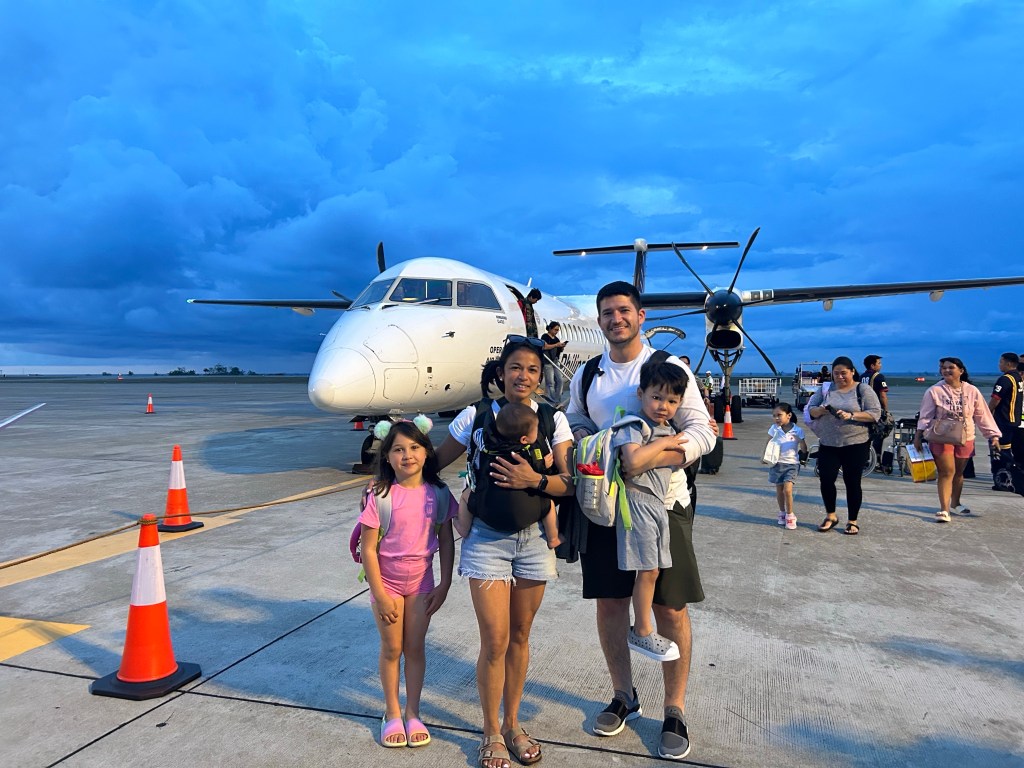
Recently, our grandson Jack ( age 6) had this Question & Answer with his Mom Lauren Canlas-Barkhurst:

Left to right: Mom Lauren, Jack, Lucy and Finn Barkhurst.
Jack: Mom, do we have a soul?
Mom: Yes, Jack, we all have a soul.
Jack: Mom, will our soul die?
Mom: I am not sure, Jack. But Jesus will be there when we die.
Jack: Ok, Mom.
At his age, Jack quickly gets the point and believes, because Mom tells him it is so.
In the case of Jack, when Mom Lauren said Jesus will be there in the end when we die, Jack simply said
“Yes,” because Mom said so. End of story. No need to fear or worry. Just trust.
German Jesuit theologian Karl Rahner, on the other hand, in speaking of God and prayer has this to say:
“ God is recognizable from his works ( even if only as the Incomprehensible above all his works). God has spoken to us in his Son ( even if the latter could only speak of his Father in human words). God has given his Spirit into our hearts ( even if we know about it for certain because the Son told us).
How then, Rahner continues, “could we not raise our eyes to him himself, open our heart and mouth in order to confess him, to say “Thou” and “Father” to him?”
We all have “earthly tents” that will be destroyed, but we also believe that we will not be annihilated to non existence but will live forever in God. We believe this both from faith and from reason.
Faith, we learned from our parents. And Reason, or more precisely, Philosophical Reasoning, we learned from school that we are creatures of flesh and spirit, that while flesh will end, spirit as a contrary substance to flesh, will not be destroyed, because our spirit, essentially is a non-matter.
I recall the first theology class I attended at the 1959 Ateneo de Cagayan ( now Xavier University) when the college rector, Fr.James McMahon, SJ substituting for our teacher who was absent, quickly started a group discussion by writing on the board: “To see is to believe. True or False?”
This started a maelstrom of a discussion which lasted quite a while and which he ended by saying, “No, when one sees, there is no need for one to believe, because one already sees. It is only when one cannot see, or cannot see clearly, that one’s action of believing is called for. And whether one believes or not, would depend on whether the person calling on one to believe is believable or trustworthy or both.
This book is also about how we tried to figure out the important things in life, for ourself.
Fear of death and dying
Once, in 2001 on a dark night on the porch of that beachfront house, I experienced what I consider a special grace. I was reading a book by Fr. Nil Gillaumette, SJ, author of dozens of inspiring books called “God Tales” and his book tells the story of a man, fearful of death, who fell asleep on his rocking chair, was then awakened gently by an angel, who said to him, ” Come, let us be on our way.” And so the man stood up and allowed himself to be led by the angel to heaven.
During that vacation on this island, my “fear of the month” happened to be that of “death and dying.” After reading that imaginative story I felt inner comfort and peace, for like the man in the story, I too in that moment was sitting on my rocking chair, looking out into the sea, and so I said to myself, “Was that man, me?” Upon my return to Cagayan de Oro, I sought out the author himself, Fr. Guillaumette who told me, after the morning mass when I saw him back at the sacristy, that at that moment, ” You received a direct grace from God.” (page 119 of this book)
Faith, I learned as a child and it is my greatest treasure. Sure, I am afraid of death but I believe in the One who has conquered death. And I will cling to that faith and hope as long as I live.
Love of God and prayer. How to love God and How to Pray.
Rahner says: “Love of God and prayer both pose a mutual difficulty for us. They both belong to acts of the heart which really only succeed when one forgets to whom one offers them – namely God – and forgets that one is doing them… One can only know whether the noble act of the heart really succeeds when one does it and forgets what one is doing. Indeed it can be – and this danger is particularly great for us people of today – that someone become so stuck in the deadly cycle of reflection about oneself that he becomes almost incapable of the real acts that are directed to God. Instead of being with God in knowledge and love, he is only with his own knowing and feeling relative to God.” ( The Need and the Blessing of Prayer, Karl Rahner, The Liturgical Press, 1997)
This word from Rahner recently came home to roost during a seminar I attended on Discipleship when I shared with my group an experience I had on prayer, which had me relating how during my prayer time, I experienced some kind of a trance-like movement (slight forward and back, body motion) which I now realize was Rahner’s rendering of me, “relating to God,” and not about the “object of my prayer”: God himself. I felt humbled and saddened at the lesson I learned. It was a bit sad yet it was grace in the form of an enlightenment. As French writer Leon Bloy would say: “There is only one sadness… that of not being holy.”
The houses of my life: A house in Anito, Camiguin island, a house in a state college in Cagayan de Oro, a retreat house in Cincinnati, and another in Lewis Center,Ohio
Well, to proceed: for someone who “loves” and who dreams about houses and islands ( not mansions, nor palaces, nor castles, nor tents, but tiny ones as well as well-crafted ones), my wife Angelita and I had built, and had lived in at least three such houses: one in the island of Camiguin, another, in Cagayan de Oro, and a third, in the small Ohio city of Lewis Center. It took us practically a lifetime to have these homes, but build them we did, except the one in Ohio, which we were able to purchase when God provided us the means in the year when we made our second big move to live in America. But I am going ahead of my story.
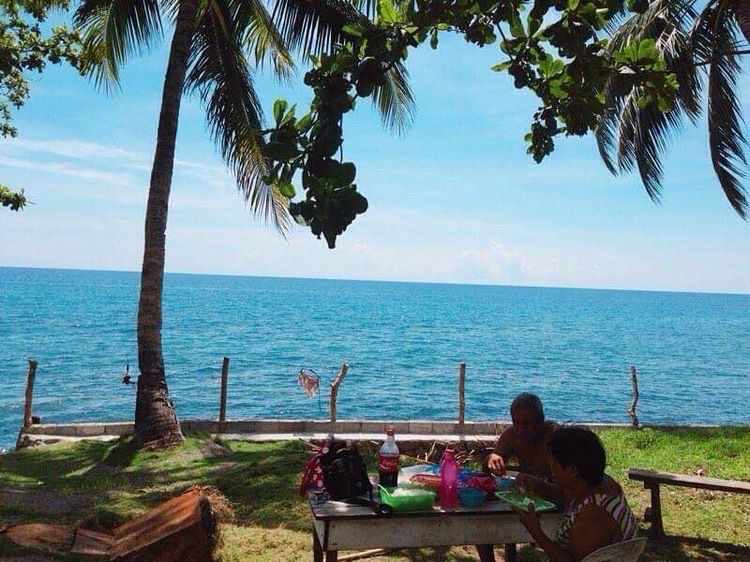
Above is the ocean view of our beachfront property in Anito, Mambajao, Camiguin
These houses lingers very much in my dreams and imagination, even after we left the island in 2004, for what turned out to be, without our planning it, a “second-chance” at another life in Ohio, where we had studied and lived previously. (1973-1980)
Tropical islands are regarded as “paradise,” but in truth and in fact, they too, like all places, are but dust to our feet, we who face dreary days everyone else does. It was on the porch of this island house, when I had a “deja vu” or an”already seen moment” as when “two streams of thought collide” in the corner of one’s mind, one of life’s moments that could only be categorized as “grace”. Page 118
“Memos” from heaven are never flatly received by us. Saying that a blessing, an event or a happening is coming, or on the way. Instead God’s will for us is “packaged” in the unfolding of our our personal history: in the people, in the places and in the events that impinge on our lives, which are so configured that sooner or later we are able to finally decipher the message(s) to us.
A house of prayer in Milford, Cincinnati, Ohio
Indeed, life’s event(s) is “the memo,” and our interpretation of these event(s), the “message.” In a six day retreat I had at the Jesuit house of prayer in Milford, Ohio in 2016, Fr. Lou Lipps said this to me: “Pay attention to your experiences. Recall the moments of the day. When did you experience “understanding,”? “consolation,”? “desolation,”? For basically these are the “movements” in your soul that one needs to not only acknowledge as at work within, but for one to discern as to what source(s) they are coming from? Are these movements coming from the Holy Spirit? Or from the enemy?”
On page 193 of this, my book, I had written of a passage that came me during my retreat in 2006 :
“It is now time to go to mass. I try to write down his (Fr. Lipp’s) instructions so I can prepare my mind for the mental work of the day following, and I try to listen to words that may come to me during mass. It is close to the end of my third day here in Milford and the words from Ezekiel gives a clue as to the Lord’s wish for me:
“I will sprinkle clean water upon you to cleanse you from all your impurities, and from all your idols I will cleanse you. I will give you a new heart and place a new spirit within you, taking from your bodies your stony hearts and giving you natural hearts. I will put my spirit within you and make you live by my statutes, careful to observe my decrees. You shall live in the land I gave your fathers; you shall be my people and I will be your God.”
Speaking of land, I think it would help if I told you a little story. In 1958, after graduation from Ateneo de Davao High School I found myself in Cagayan de Oro because Fr. Finster, rector of Ateneo de Davao told my parents that they would not accept me to Ateneo College because, as he would put it decades later, “we dont accept “bugoys” ( bad boys) in our school.” Be that as it may, I found myself in 1958 in Cagayan de Oro where there was a Jesuit college to which I, for some personal reason, desperately wanted to belong to, apparently because growing up in the Manila of 1950’s, my favorite basketball team then was the Ateneo Blue Eagles.
In a sense God gave Cagayan de Oro to me as the “land I gave to your fathers,” and now, as I write this, I realize that this land mentioned above was given to the Jesuit fathers as “mission land” too, the priests of Jesus, who guided me the rest of my life, who educated me, moulded me, and showed me how to live the faith, one of whom even cheered me on and consoled me when I, having ascended to the state college presidency in that city, and then falling from grace from the same high position, told me, “Ed, with what you are going through in that college right now, you will not have to suffer through purgatory anymore.” This, from the late Fr. Cuna,SJ who observed the excruciating experience I went through, or was going through at that time in my life.
On the sixth day of my retreat in the Milford Jesuit Retreat House in Ohio, I wrote on Page189 of this book) the following:
“I go to the chapel to pray, and John 16 comes to mind:
” I tell you this. That in me you may find peace. You will suffer in the world. But take courage. I have overcome the world.” This phrase from John was not only my umbrella and my shield in a very difficult moment in my life but it made me think that in moments of crisis, which I experienced in my career, not only is honesty absolutely necessary, but even more would be required.
A State College in Cagayan de Oro
Page 203-204 of my book tells the story.
This College in 1986 was heaving still in catharsis during a national sea change: refusing to recognize the Aquino government’s legally appointed college president prior to me; the teachers were holding classes outside the campus in protest, barricades were at the gate etc. and I was soon to be part of this.
To placate the college a search committee was formed, eventually selecting me from the six or so aspirants who vied for the position. But when I walked into the college I felt like I was entering a lion’s den in a foreign land, all eyes on me. At the gates was a placard: “Jesuit boy, get out.” After 25 years of a quiet almost somnolent academic existence at Xavier University on the other side of this town, I was soon to be introduced to something I had never seen nor will ever forget in my entire life.
I called on the Officer in Charge and showed her my appointment papers. I walked into the school cafeteria, where refreshments were served for the “new guy,” (me) when a handwritten note was handed to me by a high school girl which read:
“Sir, here, you are not against flesh and blood but against principalities and powers.”
For the first time in my life, all my senses were keen and alive. I would wake up at 3:am, alone in the president’s cottage, wondering and thinking what to do next, in this “strange campus.” When I woke up I learned that they had already barricaded my office, nailing it shut and they barricaded the gates too, hoping to paralyze the college operations.
With some help, we open up my office and alarm bells ring throughout in the campus. As if on cue, the entire college population, roused by the alarm bells, are assembled in the area below the admin offices and the “pretender” to the throne sidles up and says to me, “Please, no surprises.”
My adrenaline is pumping but I keep my peace. Finally, he asked for a “ debate” and for some reason I said yes. And so the debate was set and everything was arranged by them. It was to take place on the parade grounds of the campus, and when I arrived, accompanied by my bodyguard ( yes, bodyguard, for during this period in our country’s history, when college heads in our nation were being removed and replaced in numbers, that the violence accompanying the transitions included instances of some (of us) being shot), and I noted that on this day of the debate, everybody, but everybody, were on one side of the debate area (parade grandstand). Everybody, the faculty, the staff, the students, some parents, etc., everybody but everybody, including the janitor’s brown dog, was there, on “their” side, that is, on “his side.”
Actually, this should not have surprised me, for my “worthy opponent,” he who vied for the presidency but was not chosen, was their “hero.” Now the die is cast. I would be tripped and I would be the laughing stock of a college that wanted to vomit me out of its mouth ( and so I thought).
After the preliminary, civilized remarks, my turn to speak came, and I remember that the words I said were: ” I have come to this house in peace. I have come in to this house through the front door and have not violated any of your rights, and in fact I have entered this house with my appointment papers properly signed by President Corazon Aquino. This house does not belong to you, and I have as much right to enter this house as anybody else who comes in peace. If I entered this house through the back door, you can shoot me! But no, I have come through the front door and I have come in peace.”
Looking back on that day, I don’t know why I even used the word ” house” instead of “college” or “university,” which status the school eventually attained. Or why I even used the “shooting.”metaphor.
Truth is, after that fateful debate on campus, in the later evening hours after it, someone lobbed a grenade from the dark Hayes St., the road next to the Loyola Residence of the Jesuit fathers, which grenade landed but did not explode in the second floor hallway of the building. Fr. Nicholson saw the grenade and Fr. Millar, the superior, reported it to the Cagayan police. For some reason this. event was not widely reported to the Cagayan public. Fair enough, The grenade did not explode. No harm done.
But some years later, and this is more serious, the sitting president of that state university, someone who had succeeded me, two or three terms later, was shot and killed by paid assassins in the night, as he entered his home. Today, his murder has not been solved. May God rest his soul.
Pages 189 and 203-204 of the book tells the fuller story of how, when this episode in my life had long passed, after I had retired and had moved to Ohio and had gone on to an Ignatian retreat in Cincinnati, some 10 Philippine years and 2 Ohio summers or 4,260 days later, that a Holy Spirit prophesy from Ezekiel finally brought home to me the closure that my wounded heart craved for, and the prophesy was this:
“ For the whole house of Israel is stubborn of brow and obstinate in heart. But I will make your face as hard as theirs, and your brow as stubborn as theirs, like diamond harder than flint. Fear them not, nor be dismayed by their looks. For they are a rebellious house.” Ezekiel 3:7-9
Fact 1: The college was rebellious, stubborn and obstinate. Fact 2: My face was hard as theirs, and my brow as stubborn.
On page 206, I wrote my thoughts on the passage:
“I take this passage as meant for me alone, not for anybody else. For it speaks for itself. I recall it only now because I remember the exact moment when the school tide turned against me: It was during the PTA meeting where they invited me for the purpose of appealing a decision I made to “suspend” student leaders whom I saw at the college gate, with my own eyes, forcibly preventing/ coercing smaller high school students from entering. The Director for Student Affairs said to me, after the meeting ended: “ Sir, with your hard stance, you just lost any support the parents could have given you.”
A State College in Camiguin and coming to the deep mystery of the island
In 1996, after my years of service with the Mindanao Polytechnic State College ( now, a university), I was invited to head the newly created state college in Camiguin island. I asked then Congressman Pedro Romualdo who invited me, why he chose me? And he said: “Because I heard you are clean.” “OK,” I said, “I will come to your island.”
There is a deep mystery in coming to an island. One feels that one is coming to a place of quiet or rest, leaving behind the hustle and bustle of the world. I did not tell him that I needed such an island to rest in. As I crossed the sea, I begin to understand that indeed I am going away from men to God, to rest in His silence, to pray at His feet. My task here is to recollect myself ( nurse my wounds) so that tomorrow I might return to them, to love them and to serve them for Christ’s sake, for God’s sake.
I began to realize too, that I have yet another task to perform on my island: I must set my mind at rest and quiet my heart: detaching it from all created things in order to turn it to God, the Creator and Lover. This is what islands are for. Not everyone has an island to live on, to come from, to go home to.
But all of us must make our own islands within our hearts. Islands where fear cannot dwell, islands where we can cross over the bridge of our days to rest at the feet of our Beloved, to drink of His silence, to be made whole again and ready for the battle of tomorrow. I thank God everyday for my island.
It took me quite a while to be “healed” in my island. Years earlier, when I had fallen in love with my island, I thought that it was just a passing thing, of no moment. That must have been sometime in 1989, and I mentioned it to Gov. Nieto Gallardo, when we visited Barangay Ytum at the foot of Mount Hibok-Hibok, where he was reforesting the mountain.
When I finally lived and worked in Camiguin, in my heart I thanked God for honoring my yearning for more solitude and quiet. Because, you see, when I was recovering from my experience in that state college in Cagayan de Oro, after my family and I had evacuated to a safe house in front of St. Mary’s School; after I had “lost” the power, the perks, the prestige, etc., I now walk down that hill, instead of being driven by my personal driver, in my presidential car, so I walk down forlorn and utterly alone, and I cling tightly to my brown leather office bag, and not knowing what to do or where to go, and I then simply and quietly and possibly in tears, asked Our Lord: “Lord, where are we going now? What are we to do?”
For you see, I had reached not only the bottom of that hill but also the bottom of my life and I had to decide: “Should I turn left? Or, right?” And so I asked Him, “Lord, where do we go now?” The Lord was silent, as usual. He always is. Like when I asked Him when I was in Grade 4: “Lord, can I see your world?” Or, when I was on board an American Airlines jet from New York to LA, in 1963 after my studies in Nova Scotia, when I asked again, “Lord, why me? Why did you choose me?” Or, in 1967, when I saw my bride walking down the aisle and I said, ” Thank you, Lord, for giving my Angelita to me.”
I told you: I remember “everything,” like how I miss my love in the morning light, like roses miss the dew.
Grace of Remembering
The rest of this book is about similar graces. As I would write later in this book, “My hope is that you too, would see the hand that guides you, and the Spirit that inspires you.”
Comments from my readers:
Panny Gagajena, (California)
After the Vegas Convention I found time to read your book after a few days’ rest. After reading a few pages, I couldn’t put it down. It was so good and engrossing. I’ve been to Cagayan de Oro a few times, and of course I grew up in Davao. You wrote about familiar places and names. I was intrigued when reading your Davao chapter. I thought you might eventually identify your “first love” in high school. I’m sure I will know her by her last name, if not the first.
But getting back to my book critique. There are passages so well written that to me they almost look like poetry in prose. Of course your “spiritual moments and encounters with nature and God” are so stirring and moving, I could almost touch the “divine”. I could almost see myself writing like you in certain passages of your book. I will read your book again a second time in between my exercising, baby-sitting, golfing, fishing, classical guitar playing, and my own occasional writing. I’m so inspired by you that now I really have to finish my own autobiography I had started to write in 2004. It has been planned for at least 24 brief chapters. I was stuck in chapter 4 when I was writing about my Growing Up Years in Davao. Looking back, I only knew you as good HS Varsity player. But I couldn’t imagine you turning out to be a writer with a Doctorate in Economics, and a Community College President.


Photo: Book launch in Cagayan de Oro City, 2013 L-R: Emil Bolongaita, author, Angelita Canlas, Lulu Bolongaita, Charisse and Rafael Fortich
Dr. Narciso S. Albarracin, Jr. (Arlington, Ohio)
I enjoyed reading your memoir and reflection. How clever it is for you to anchor your recollections and remembrances on the houses: taking advantage of your family’s unusual mobility. It gave me a tinge of sadness to see the conclusion of this warm and honest and lyrical and profoundly reflective memoir.
Atty. Leo Gutierrez, Reno Nevada
Frankly, there is nothing I can add to your Obra Maestra.
Ella Abaya-Palaypay (Edmonton, Canada)
Thank you very much. My Mom read your book the minute she received it. She has been reading it over and over and have shared your story with other family members.She was very happy to hear from you. Thank you again. (Letter from Jean’s daughter, Ella) Note: Jean was my high school sweetheart.
Susan C. Bolongaita, Dublin, Ohio
Uplifting. Soulful. Inspiring. A true journey of the soul. A fun adventure. Wonderful and empowering for readers to think about their own desire to serve the Lord but who may not have the leisure of time or the blessing of going on a retreat, but still want to experience what you experienced. Could be a guide for souls thirsting for grace. I felt grace reading through it.
Dr. Lourdes R. Quisumbing, former Philippine Secretary of Education
It was a wonderful experience for me to go through your “prayer journal.” It is a wonderful meditation piece and a great mirror of your soul and your journey to find God’s love in your life, your loved ones and in nature. Your book reverberated in my soul.
Fr. Rod Damico, St. Paul Parish, Westerville, Ohio
A beautiful reflection. I was deeply moved by your life’s story and your intimate encounter with The Lord at Milford (Ohio). It’s a lovely place. God bless.
Bobby Cabrera, Brotherhood of Christian Businessmen and Professionals, Cagayan de Oro City
Wow. It is so well written. I did not stop reading till I finished it in one sitting. Congratulations.
Elvira F. Du, Faculty, Ateneo de Davao University
I scanned your manuscript intending to read it for later. However, I got caught up in the material. I am amazed at your level of spirituality as reflected in your writing. Your “Houses” came across to me, however, as sad. I don’t know why.
Cora Quisumbing-King, Phd, University of Chicago
Your book, as you very well know, is a very good book. It is a gift. A masterpiece in its own right. I like the way your heart and mind blends.
Brix Marzan, Toronto, Canada
You should read this book. It is beautiful.
Bron Almendrala, New York City
“Houses of my Life” is one of the most intimate, honest and uplifting books I have read. It felt like stepping out from a smoky room and getting some fresh air. Such an amazing perspective on life and tremendous attention to detail. Every time I read descriptions of a particular place or subject, I can almost hear a fondness from the author’s voice. Quite frankly, I think this book is simply about a life well lived.
Ramon Kimpo, Jr., Mission Viejo, California
This work is awe-inspiring.
Judy Carrasco, Durham, North Carolina
Your memoir has special meaning for me. I’ve never been to the Philippines and through your book, you’ve given me a glimpse of its life and culture. I greatly enjoyed how you interspersed prayers with inspirational lyrics, as well as stories from your own life and parables. Your insights are very poignant and philosophical, and I truly got the sense of being privileged to understand your particular view of the world.
Silvino Balaba, Queensland, Australia
Interesting, captivating, highly recommended reading.
Fabiola Gorospe, Gardena, California
It is too inspiring. I am just inspired and overwhelmed. It’s truly inspiring to read your book.
Rita Bouffard Bornsheur, Silver Springs, Maryland
Enjoyed reading your manuscript. I could’nt put it away. I had to read it all, right away. It’s amazing how your memory bank works for you. Warm memories that are just very true to life. Sensefully exciting and funny, lathered with just a touch of a good, God-fearing soul. A special individual who showed me a different facet of his life from one when he was younger ( in Davao). I had a peaceful, nostalgic feeling reading through it.
E.B. “Yoyoy” Serina, MD, Long Beach, California
All too often what escapes us is that the things that happen in our lives have been witnessed by the houses we lived in; and getting into them reveals, oh so fascinating experiences. Clever. Amazing. Brilliant. The journey was vivid in the places it went through. Equally vivid, if not exceedingly so throughout is the mind set of the writer: peaceful, fair, family values, nature and natural phenomena, unyielding, determined on a goal eventually leading to the ultimate spirituality of man. I am honored to have shared them “houses of your life”.
Corazon C. Munoz, Professor, Capital University, Columbus, Ohio
Impressive. Inspirational. A genius of a work. What details you remembered. God blest you with beautiful memories to recall the life he has given you in all its minutiae to share so you can touch the lives of many with God’s love. What a moving, poignant story of life, relationships, fears, visions, dreams, joys, sadness, anxiety, hope and love of God that permeates all your houses. I was glued to this book with tears in my eyes and full of joy in my heart. You moved the plot from house to house yet took us with you on vivid trips, with heartfelt emotions in between. This book is riveting, with sensitivity, with historicity and with grace, as beautiful words and even incomprehensible terms are clarified in the context of the story. It conveyed genuine-ness and a warmth like that of an innocent child fully dependent on God’s grace.
Ben Ferrer, Alhambra, California
Your view of life after 65 is most edifying. If someone were to confide in me that they never expected that someone like you could write such a book, I would reply ( in pidgin Visayan-English, of course): ” You cannot sure (sic) the man “under the mango tree.”
Antonio “Nono” Montalvan, Writer, Vera Files, Philippines
Your manuscript sounded as though it was written by one who had just gone through one’s fieldwork, describing the life of the people he had just seen and observed, but more importantly, had participated with and considered from the prism of one’s own perspective for others to know and learn. I think therein lies the strenght of your stories. Congratulations for the feat and the determination.
Augustus Santos, former Dean, Xavier U. Aggie College, Cagayan de Oro City (lives in New York City)
I found myself glued to your book, unable and unwilling to separate myself from it. My heart really went out to your recollections. Your discovery and acceptance and proclamation of life helped me to see clearly our God as a loving Creator. Thanks for helping me to see life clearer through your awesome and beautifully written work.
John Higgins, former cop, New York City, and expat in Camiguin Island ( now lives in Long Island, New York )
I really like this book: let me count the ways. Where else can one find a history of Camiguin and Mindanao except for Dr. Ed’s book? It should be required reading for all high schools and college students in Camiguin and Mindanao.
Dr. Ed gives us and intricate account of the geological forces that formed Camiguin and Northern Mindanao as we know it today.
Also he gives a lively and animated account of the human history of this beautiful island up until the present. Starting from the time of the early Spanish conquistadors through the defining events of the Second World War .
He delves deeply into its history. He gives eye witness account of spectacular volcanic eruption and floods, and earthquakes, as well as lovely descriptions of Camiguin sunsets, hot spring/cold springs, waterfalls etc. He tells of the tears and hardships of a struggling people with beautiful smiles.
I’ll give an example (see page 56, Hymn to Saint Joseph)
Almost every Saturday for 23 years I’ve kind of sort of sung this hymn but I didn’t understand it completely.
Now thanks to his book with his English translation I know what I’m singing. He writes of the brave, good people that saved the parish priest from the Japanese invaders, etc.
Brothers, Dr. Ed is a brave man who tells it like it is. He writes of a political system that buys votes for a sack of rice.
He goes deeper, much deeper into a culture that sustains corruption, and hypocritical or almost schizophrenically ignores it.
But, my dear people: sin and selfishness is the result of our original sin. Corruption exist quite well in Chicago and New York every bit as it does in Mambajao, Camiguin.
John Higgins, ex Vietnam vet, former NY cop; was resident of Tupsan, Mambajao for 25 years.

Our house in Camiguin Island ( in better days)

 BCBP Ohio Journal & Learning Resource