

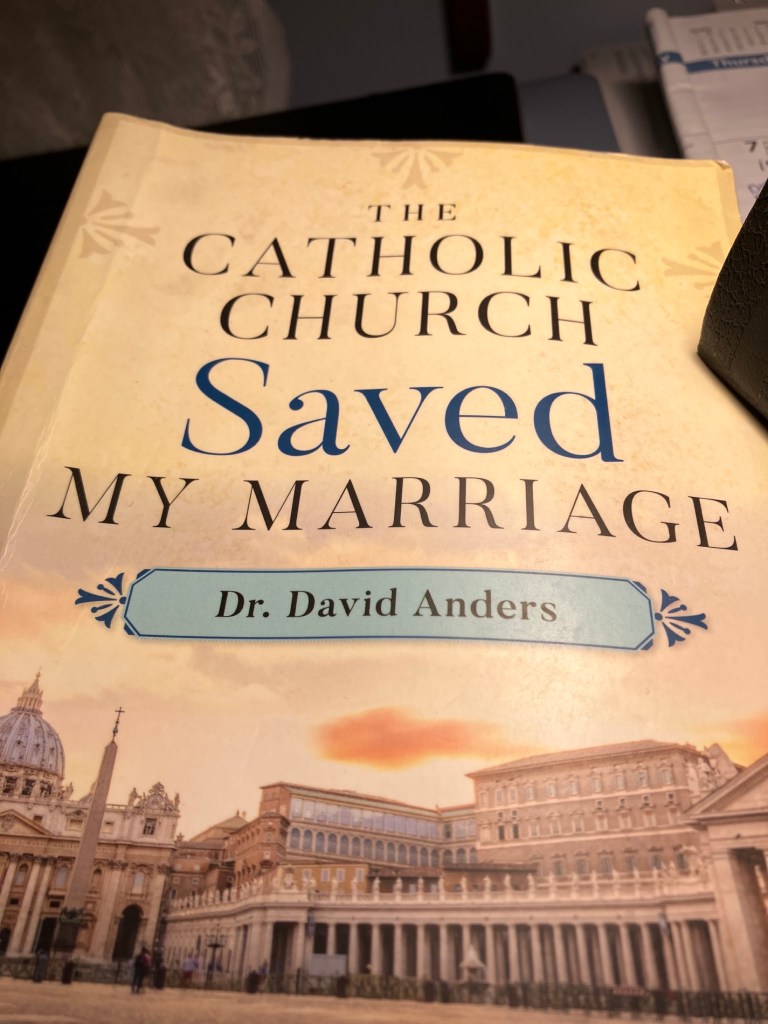
From David Ander’s’ book: “ How the Catholic Church Church saved my marriage,” EWTN Publishing, 2018
“ The lecture was another important stepping stone on my journey to the Catholic Faith… Professor Gaffney made no appeal to Scripture or to Sacred Tradition. From reason alone, he argued for the objective value of unborn human life.
Gaffney surprised me by refusing at the outset to engage in political discussion…Gaffney confessed that he found pro-life politics impractical because he didn’t believe it was possible to legislate successfully against abortion.
We might dispute this, of course, but his lack of political interest noticeably lowered the emotional temperature in the room.
Gaffney asked a simple question: Is it possible to say meaningfully, “ When I was a fetus?”
He drew our attention to a basic moral intuition: The Golden Rule presupposes that I can imagine myself in someone else’s situation. “ If I were in his shoes”, we ask ourselves, “ how would I like to be treated?”
There are conditions in which this makes no sense; for instance,I cannot imagine myself as a stalactite.But it is perfectly intelligible to imagine oneself as a fetus because, in fact, I was a fetus. Therefore, it makes sense to ask, “ How would I want to be treated if I were a fetus? Would I want to be aborted?”
Citing the “ principle of reasonable doubt,” Gaffney asks: “ If we don’t convict a criminal when there is reasonable doubt of his guilt, then why should we kill a fetus if there is even a reasonable doubt about its status as a moral object?”
…Today, I can’t help thinking about Professor Gaffney’s lecture when I remember the time I first told my young daughter: “ Why would anyone do that?” she asked me. “ They wouldn’t want to have been aborted.” I laughed when I realized what this meant: it took a PhD ethicist to teach me what even a little child could know.
 BCBP Ohio Journal & Learning Resource